A discussion of contemporary issues in media ethics, with olives and a twist. Made with only the freshest ingredients, shaken, stirred and poured over ice. I should also mention that I do like the odd, occasional martini. Bombay Sapphire gin and Lillet, dry and plenty of salty olives. Welcome to this cocktail of journalism and alcohol. A fine combination!

Wednesday, 15 August 2007

A commercial news media blog about journalism - a rare bird?


Public Eye: CBS News Blogs and Editorial Forum - CBSNews.com

The CBSNews.com website hosts an interesting blog that I've just come across. (I know, you've all been there, done that.) It's a noble mission on behalf of CBS...

Public Eye’s fundamental mission is to bring transparency to the editorial operations of CBS News — transparency that is unprecedented for broadcast and online journalism.
That's totally refreshing. It's not just CBS journos posting here, the key dude is Brian Montopoli, who previously worked for the respected Columbia Journalism Review.
Public Eye's worth checking out and there's an RSS feed available too.

Tuesday, 14 August 2007

A clever con...or a miscarriage of justice?


TV3 > Programmes > News and Current Affairs > 60 Minutes

I'm not normally one to praise the 60 Minutes programme, in fact as a rule I don't watch it. But this week, perhaps as a result of being immersed in a conference about how much journalism actually matters to our society, I decided to catch up on some current affairs TV when I got back to Auckland.

I watched Campbell Live, which I must admit doesn't thrill me at all, but then the promos for 60 Minutes came on and I was fascinated with their lead story about a young Iraqi man who's been convicted of smuggling drugs into New Zealand.

Mazin Jaburi claims that he smuggled over $200K of ecstasy from Amsterdam because a criminal gang in Baghdad had kidnapped his sister and threatened to kill her.

Initially the NZ customs service believed him and the police took Mazin to his hotel where he was to hand over the drugs. But the next day he was arrested and charged. The court/jury did not believe his story and he was found guilty. He is to be sentenced in the Manakau District Court next week.

The defence counsel claimed to have proof of Mazin's sister's kidnap and murder, but the evidence was not allowed at the trial because the prosecution said it would not be able to cross-examine witnesses. Mazin's cousin was prepared to travel to NZ to give evidence, but he could not secure a visa.

I've spoken to Sarah Hall, the 60 Minutes' reporter covering this story. Like me, she has doubts about the safety of Mazin's conviction. She says that the programme is hoping to do a follow-up.

I've also spoken to Mazin's lawyer, David Niven, who obviously has to be circumspect in what he says because the matter is still before the courts. It is unlikely that this matter will be over when Mazin is sentenced next week.

I think this is a potentially serious miscarriage of justice, or at least an unsafe verdict, and I'd urge you to watch Sarah's story at the 60 Minutes / TV3 website. It seems to me that this is a case that might well be taken up by any "Justice Project" groups in New Zealand who care to take a look.

I have no real way, at the moment, of establishing Mazin's guilt or innocence, but according to New Zealand law, the crown has to prove a case beyond reasonable doubt to secure a conviction. I have some reasonable doubt about this case.

Kudos to Sarah Hall and 60 Minutes for running this story. I hope they are able to follow it up and that civil rights activists in New Zealand also take a look at the trial, the evidence and the process.

There's a good possibility that Mazin may go to gaol for up to 10 years, as he says in the 60 Minutes' story, the death of his sister seems punishment enough.

Monday, 13 August 2007

Journalism Matters, summary of outcomes

Here's Simon Collins, NZ Herald social affairs reporter and EPMU delegate's summary of the Journalism Matters conference held over the weekend 11-12 August in Wellington.

About 115 people attended the media summit organised by the journalists' scetion of the EPMU at Parliament over the weekend, including journalists from all sections of the media. There has been nothing like it in my 31 years as a journalist.


Outcomes were (summarised):
1. The EPMU will lead a review of journalism in NZ over the next 6 months, inviting public submissions on the effects of growing commercial pressures on journalism, journalists'pay rates and the resulting loss of talent to PR, freelance pay rates, union membership, public interest broadcasting and the growing pressure on journalists to serve multiple media at once.
2. The EPMU will also review the Journalists' Code of Ethics, available as Rule 42 of the EPMU rules at:
http://www.epmu.org.nz/SITE_Default/about/rules/default.asp
Public submissions will, be sought for this review too. The code needs to be updated to take account of new technology.
3. We want taxpayer funding of TVNZ to be increased to a level that allows it to be a true public service broadcaster.
4. We urge everyone concerned about democratic media to take every opportunity to create new media outlets committed to providing people with information about public issues in a coherent form, facilitating an exchange of ideas about those issues and building a sense of social cohesion as a foundation for social action.
5. We support the work of the Bruce Jesson Foundation and urge other funders to fund independent investigative journalism on important public issues.
6. We will establish a Movement for Democratic Media, with membership open to all NZers as well as the union, to create, support and link local websites and other media outlets reporting on public issues, and to campaign for publicly funded broadcasting. We hope to organise a planning meeting to establish an Auckland branch of the movement in the near future. If you're keen to be involved, please let me know.

Simon

I was interviewed by 95bFM on Sunday morning about the conference, you can hear the audio here.

David Robie, my colleague at AUT, has also blogged on this at the Pacific Media Centre website. You can also read and hear more at Scoop
David's blog on the conference is at Cafe Pacific

APN begins editorial outsourcing

Media began outsourcing editorial production work in New Zealand yesterday, in a strategy being watched by media outlets in other countries.

A contractor, Pagemasters New Zealand, is now doing the editing and layout work for The New Zealand Herald and several regional and weekly papers.

APN says 20 full-time sub-editors at Pagemasters started work on Sunday in Auckland on an extension of the group's computer editorial production system.

APN deputy chief executive Rick Neville said that by the end of 2007, Pagemasters will have about 45 editing staff to edit the seven newspapers. That is nearly 30 fewer than the newspapers employed for the job.

Pagemasters is a subsidiary of the Australian Associated Press news agency.

The Engineering, Printing and Manufacturing Union has said the move will erode the quality of news coverage because stories will be handled by editors unfamiliar with local issues.

Journalism Matters


Over the past weekend 11-12 August I was in NZ's very own "windy city", the capital Wellington for a conference hosted by the EPMU, which has the journalists' union tucked up inside it. EPMU stands for Electrical, Print and Manufacturing Union and the journos ended up there after a series of amalgamations forced on the trade union movement by the neo-liberal policies of successive New Zealand governments.

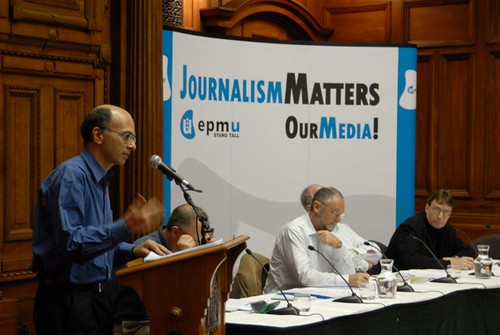
[Photo right: Simon Collins, EPMU delegate at the New Zealand Herald]


The journos' union is not in great shape. It appears that membership is falling and that 'density' the ratio of unionised to non-unionised workers in any newsroom is also low.

But the conference itself was interesting. At the end of the first morning I was asked to sum up the day so far. Here's a copy of my notes:

Citizen. Journalist.
We're all agreed that a well-functioning media is a critical element to a functioning democracy. However, I think we should start by putting an emphatic full-stop between the words Citizen. and Journalist.
All journalists are citizens, but the question today is: "Are all citizens journalists?"
Clearly the answer is not yet.
This raised the issue of filtered versus non-filtered news. It also suggests the combination "citizen-hyphen-journalist" and the attendant quality issues.
I'd prefer to talk about "DIY", do-it-yourself journalism, but is it really journalism?

Then there's the link between "celebrity" and journalism. There's journalism about celebrities (perhaps a dumbing down of the news agenda) and there's "celebrity-hyphen-journalist". This is the situation where the personality of the journalist (mainly in TV, but also in blogging and columns) takes over.

Convergence and new technologies
What will the journalists of the future do? More importantly, who are they?
There was considerable discussion of digital convergence and the issues of cross-platform journalism. Is it the case that in the future, if reporters are required to work across platforms that they risk becoming competent in video/audio/photography and writing, but not really masters of any discipline.

Workloads associated with repurposing copy also raised issues, particularly in the context of the low wages and poor conditions "enjoyed" by working journos in New Zealand. One student from Massey even pointed out that she earns more as a waitress in a Wellington restaurant than she will in a newsroom after four years of study.

the key issue for me is that we shouldn't get too hung up about platforms. Convergence is not going to go away and in the scheme of things the "digital revolution" may yet have some way to go. If it's anything like the industrial revolution, it go on for another couple of generations, at least.

In that context the important thing to remember about journalism is that the key intellectual skills of a journalist - the ability to "record", "disclose", "remember" and "entertain" will not go away either. I believe that journalists are quotidian intellectuals. They are the public intellectuals of the everyday. Their job is to do more than merely report, there is a role for interpretation, analysis and critical thinking.

Demography
Is the changing face of New Zealand represented in the media? The short answer is no. Most journalists are from fairly priviledged white, middle class backgrounds, but New Zealand's population is changing. Maori and Pasifika populations are growing and so is the "Asian" community. I always feel uncomfortable talking about the "Asian" community in such broad terms. It's made up of many different national and ethnic groups and they each deserve recognition. Chinese, Korean, Thai, Vietnamese, Laotian, Burmese, Japanese, Indian (Sikhs, Hindus, Tamils, Pakistanis, Sri Lankans, Muslims and Christians).

Journalism schools are also struggling with this population shift.
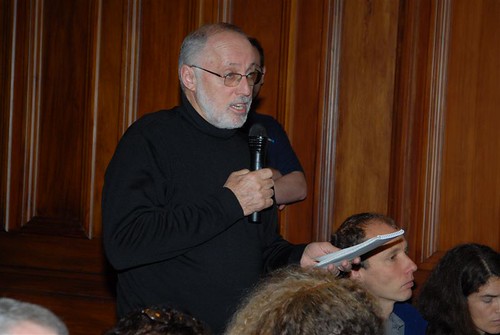
At AUT University we're trying to increase our appeal in non-white communities, with, so far, limited success, but we're working on it. According to JTO (Journalists Training Organisation) figures there is still a large gap between the general demographic profile of New Zealand and the graduates from the j schools.
[Photo right: Jim Tucker of the JTO]


There's also an age issue in terms of the NZ demographic picture. People under 25 generally don't read newspapers, while those over 50 do. This is certainly having an impact on both the commercial and the content side of the news in print and broadcasting. Which led me, in a round-about way to talking about political economy.

Political Economy of News Everyone seemed concerned about the impact of globalisation on the New Zealand news industry. New Zealand has one of the most concentrated and foreign-dominated media industries in the world. This work by Bill Rosenberg spells it out quite clearly. There are some good tables and figures in Bill's work. There was a sentiment that globalisation leads to a homogenisation of the news agenda and an element of "dumbing down" the news to lowest common denominators.
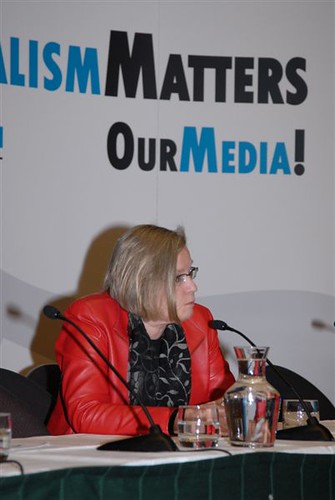
A key issue then, is can good journalism coexist with corporate ownership. As Judy McGregor pointed out, this is an important fault line in the media. It cannot necessarily be solved by changes and reforms, such as cross-media ownership laws.
[Photo right: Keynote speaker, Dr Judy McGregor]


Wages and conditions
All that really needs to be said is that they are bad and getting worse. It was good that Rick Neville from APN and several executives from Fairfax were there to hear this, but we're yet to see if it will make any difference. Frankly, without some kind of mega industrial campaign that is absolutely illegal under NZ industrial law, this is not likely to change.

However, several speakers, including Chris Warren of the Australian journos' union, the MEAA, made the point that the quality of news must also be an industrial issue. Certainly this was strongly expressed during an afternoon session on media ethics. The collective action of organised labour is a key strategic weapon of the unions. At least it should be.

The union needs to do lots of work to improve its coverage and its clout in New Zealand newsrooms.

Finally we talked about the public-union interface and the need for some kind of real public and political campaign. Hopefully this is about to begin. AUT journalism school is hosting a meeting in Auckland on 22 August to launch a campaign committee.
More on that later

Columbia Journalism Review - new updates


The latest from Columbia Journalism Review:


Dear Readers,
Good morning. Here’s the latest from Columbia Journalism Review:
The Greenhouse Effect
Gal Beckerman on how Hurricane Linda blew C-Span away
To Juice or Not to Juice?
Curtis Brainard on how several journalists are floating the idea of legalizing doping in sports
The Good-Citizen Quiz
Michael Schudson and Tony Dokoupil on what Americans know about their nation
We hope you enjoy these articles. Please consider a subscription.
The Editors
To SUBSCRIBE, to give CJR as a GIFT, or to check STUDENT RATES, go to www.cjr.org/subscriptions.

Friday, 10 August 2007

Fourth estate won't bow to digital age - Business - Business - smh.com.au

Fourth estate won't bow to digital age - Business - Business - smh.com.au

So are newspapers dying or not? Are they a little bit sick, or is it terminal?

According to News Limited CEO John Hartigan, newspapers need to aggressively market themselves as interpreters of the news, not just providers. In a speech this week to the Pacific Area Newspaper Publishers' Association (PANPA), Hartigan also called for more "crusading and campaigning journalism".

This is actually a scary thought - most of News Limited's papers, which dominate the Australian market, are conservative and more prone to spreading moral panic than crusading analytical journalism.

Look out for more tabloid-style crusades from the Daily Telegraph, the Herald Sun and the Australian. No paedophile, drug-addicted single mum or drunken Aborigine will be safe from the News Limited rain of terror.

Is there really though a new virtual public sphere -- a 'fourth estate' of the internet? I'm not yet convinced as I told my students the other day. The interent is rapidly being suborned by the very same large old-media companies who currently dominate the print and broadcast media. In this climate there's no greater freedom available to journalists of either the professional, or the 'citizen' type.